Why Your Pull-Up Range Shrinks Before Your Reps Do
Quick Answer: As you fatigue, your body preserves rep count by quietly cutting range - a little less at the bottom, a little less at the top - because a shorter rep needs less force. Range collapses before reps do, so a set of five with declining range is not the same training stimulus as a set of five full reps, and comparing them week to week tells you nothing. Tracking range rather than reps is what turns pull-up training from a plateau into a progression.
Here is what is being lost, why the bottom inch matters most, and how to measure it without equipment.

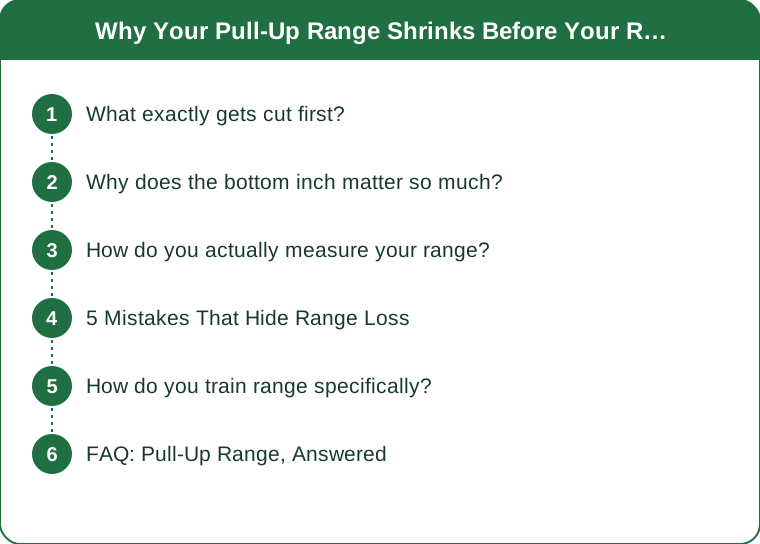
What exactly gets cut first?
The bottom, then the top, in that order.
The bottom of the pull-up is the hardest part. From a full dead hang, your lats are at their longest and least mechanically advantaged position, and the scapulae have to move from fully elevated into depression before the arm can even begin pulling. That initial phase costs the most force.
So the first thing fatigue takes is the dead hang. You stop just short of full extension, keeping a slight bend in the elbows and the shoulders slightly engaged. This feels like a small thing and it removes the most demanding portion of the rep.
Then the top. Chin over the bar becomes chin at the bar, then chin near the bar. The top range is where the biceps and upper back finish the movement, and it is the most visible part - which is why people notice it and miss the bottom entirely.
And then the tempo. The last thing to go is control on the way down. Dropping rather than lowering removes the eccentric portion, which is where a large share of the strength adaptation comes from.
Notice that all three happen before the rep fails outright. The set does not end when you can no longer do a pull-up; it degrades through several stages first, and every stage is a reduction in the stimulus you were training for.
Why does the bottom inch matter so much?
Because it is the part that builds what you actually want.
Full range trains strength at length, and strength gains are somewhat specific to the range in which you train. Training only the top half builds a strong top half and leaves the bottom exactly where it was - which is why partial-range pull-ups plateau so reliably.
The dead hang position develops scapular control. The transition from a passive hang to an engaged, depressed scapula is the foundation of shoulder health in pulling movements. Skipping it means never training it.
And it is the part that transfers. Most real-world pulling and climbing demands start from a long, extended position. A pull-up that only exists in the top third does not transfer to much.
There is also a measurement problem. Partial reps make progress impossible to track. Five partial reps this week and five partial reps next week could represent improvement, decline, or nothing at all, because the reps are not the same movement.
And the shoulder consideration is worth stating: for most healthy shoulders, a full dead hang is appropriate and beneficial. If a full hang produces pain or a pinching sensation, that is a reason to see a professional rather than to permanently train partial reps around it - the pain is information, and working around it indefinitely tends to entrench the problem.
How do you actually measure your range?
Three methods, none requiring equipment.
Film the set from the side. The most reliable. Watch for whether the elbows fully straighten at the bottom and where the chin ends up at the top, rep by rep. You will almost certainly find the decline starts earlier than you expected - most people are surprised by rep three, not rep five.
Use an audible cue at the bottom. A brief pause at the dead hang - count one at the bottom of every rep. If you cannot hold the pause, the rep would have been cut. This turns the cut into an obvious failure rather than an invisible one.
Set a physical marker at the top. Touch your chest to a fixed point, or touch the bar with your upper chest on a chest-to-bar variation. A binary target removes the gradual creep entirely.
Then apply a simple stopping rule: end the set on the first rep where range shortens. Not when you fail. The rep after the range cuts is training something other than what you intended.
And record reps in a way that captures this. Logging ‘5 pull-ups’ hides everything. Logging ‘4 full, 1 partial’ is honest and it makes the next session comparable.
One useful benchmark to track alongside: how long you can hold a full dead hang. Dead hang duration correlates well with pull-up capacity and it is easy to measure precisely, which makes it a good progress marker when rep counts are noisy.

5 Mistakes That Hide Range Loss
1. Counting reps as the only metric. The root of the problem. Reps are easy to count and they conceal everything that matters about how the reps were performed.
2. Going to failure every set. The last two reps of a to-failure set are almost always the degraded ones. Stopping one or two short of failure keeps the whole set at full quality, and for most people produces faster progress in this specific movement.
3. Using kipping or momentum without noticing. A small swing creeps in as fatigue builds. It is generally not a conscious decision - filming is the only reliable way to see it, and it accounts for a lot of mysteriously inconsistent pull-up numbers.
4. Comparing across different bar heights. A bar you have to jump to reach means starting reps with residual momentum; a bar where your feet are close to the ground invites a subtle push off. The same person can differ substantially between two bars in the same gym.
5. Ignoring the eccentric. Dropping from the top removes the lowering phase entirely. Eccentric loading contributes a large share of strength adaptation, and dropping also loads the shoulder abruptly at the bottom - the worst of both.
The one that surprises people: the first rep of a set is frequently not the best one. Rep one often has less range than rep two, because the body is not yet fully warmed and coordinated. Two easy warm-up reps beforehand usually fix it - and it explains a lot of otherwise confusing session-to-session variation.
How do you train range specifically?
Target it directly, rather than hoping it comes back.
Dead hang holds. Build a comfortable 30 to 45 second full hang. The position you cannot hold is the position you cannot pull from.
Scapular pull-ups. From a full dead hang, depress the scapulae without bending the elbows - a small movement, and the exact transition that fatigue removes first. Sets of 5 to 8.
Bottom-range partials. Deliberately train the first few inches from a dead hang. Counterintuitive but effective - if the bottom is the weak point, train the bottom.
Negatives with a pause at the bottom. Jump or step to the top, lower slowly over 5 seconds, and hold the dead hang for 2 seconds before releasing. This trains the eccentric and the end position together.
Band-assisted full-range reps. Assistance is greatest at the bottom, where a band is most stretched - which happens to be exactly where you need it. Better than doing partials unassisted.
And structure sets for quality: more sets of fewer reps. Five sets of two full reps beats two sets of five degrading reps for the same total, and the total quality volume is higher.
Progress the range before the reps. Full range at three reps, then four, then five - rather than five reps of steadily shrinking range. This is slower on paper and considerably faster in practice.
This is general fitness information, not medical advice. If a full dead hang causes pain, pinching, or numbness, get it assessed rather than working around it - shoulder pain in a hang can indicate an issue that training through will not resolve.
FAQ: Pull-Up Range, Answered
Why does my range shrink before I fail?
A shorter rep requires less force, so cutting range is how your body preserves rep count under fatigue. It happens without any conscious decision, which is why it is so easy to miss.
Should I go to a full dead hang every rep?
For most healthy shoulders, yes - the bottom position is where the hardest work and the most useful adaptation happen. If a full hang causes pain or pinching, get it assessed rather than permanently training partial reps.
When should I end a set?
On the first rep where your range shortens, rather than at failure. The reps after that point are training something other than what you intended.
How do I know my range is shrinking?
Film the set from the side. Almost everyone finds the decline starts earlier than they expected. A brief pause at the bottom of every rep is a good real-time substitute.
Are partial reps ever useful?
Yes, when deliberate. Bottom-range partials specifically train the weakest part of the movement. The problem is unintentional partials that masquerade as full reps in your log.
Why is my first rep sometimes worse than my second?
The body is not fully warmed or coordinated on the first rep. Two easy warm-up reps beforehand usually resolve it, and it explains a lot of session-to-session inconsistency.
What is a good progress marker when reps are noisy?
Dead hang duration. It correlates well with pull-up capacity, it is easy to measure precisely, and it is far less affected by day-to-day variation than rep counts are.
TL;DR:
- Fatigue cuts range before reps - the bottom first, then the top, then control on the descent.
- The bottom inch is the hardest and most valuable part, where the lats are longest and the scapulae have to move.
- Partial-range training builds a strong top half and leaves the bottom unchanged - which is why it plateaus so reliably.
- Film the set from the side. Most people find their range starts declining at rep three, not rep five.
- End the set on the first shortened rep, not at failure, and log it honestly (4 full, 1 partial).
- Train range directly: dead hangs, scapular pull-ups, bottom-range partials, slow negatives with a bottom pause, band assistance.
- More sets of fewer full reps beats fewer sets of degrading ones - and dead hang duration is a cleaner progress marker than rep count.
The set you logged is only useful if it is the set you actually did.
This is general information, not medical advice.
Keep Reading
This article is for general informational and styling purposes only. Fit, sizing, and product availability may vary.