Why Does Your Breathing Decide the Last Two Reps of a Pull-Up Set?
Quick Answer: Pull-ups depend on a braced, pressurized torso to transfer force from your arms to your hips. Most people exhale fully at the top of each rep, which drops that pressure and leaves the next rep starting from a soft trunk. Taking a partial breath at the bottom and holding roughly 70 percent of it through the pull keeps the torso rigid — and typically adds one to two reps immediately, with no strength change at all.
You can do four strict pull-ups.
Rep five, you get halfway and your body starts to fold in the middle rather than the arms giving out.
That fold is a breathing problem wearing a strength problem’s clothes.

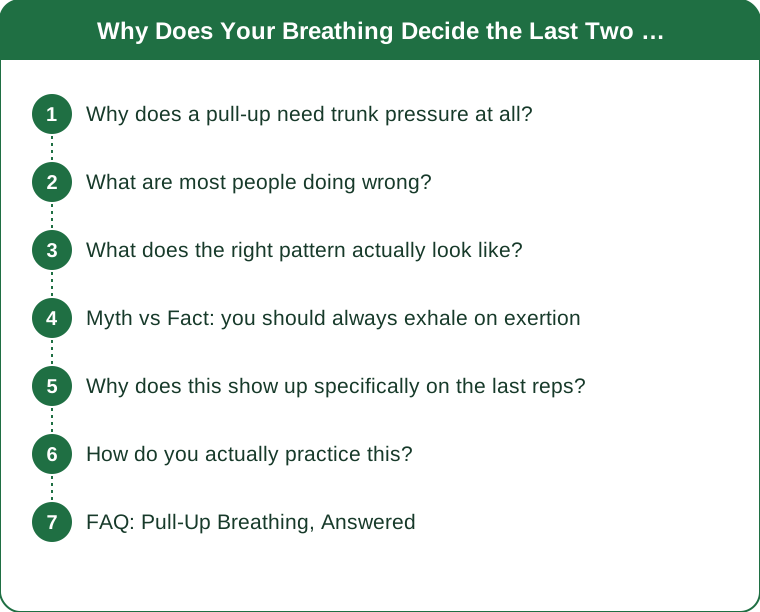
Why does a pull-up need trunk pressure at all?
A pull-up looks like an arm and back exercise, and it is. But the force your lats generate has to travel through your torso to your pelvis, and a torso that is not braced leaks that force.
When you take a breath and hold part of it while bracing your abdominals, you create intra-abdominal pressure. That pressure turns your midsection from a flexible tube into something closer to a solid cylinder. Force applied at the top travels efficiently to the bottom.
Exhale fully and that cylinder collapses. Now your ribs can flare, your pelvis can tilt, and your body can pike or arch. Every one of those movements absorbs force that was meant to lift you.
This is why a hollow body position is coached in gymnastics before pull-up volume is added. The position depends on pressure, and pressure depends on breath.
Your lats can only pull as hard as your torso can transmit.
What are most people doing wrong?
The most common pattern is exhaling at the top of every rep, which feels natural because the top is the hardest part and exhaling with effort is instinctive.
The problem is what happens next. You are now at the top of a rep with an empty torso, and you descend in that state. The lowering phase is where you would most benefit from rigidity, and it is the phase you have made softest.
Then you arrive at the bottom needing to inhale, so you take a breath while hanging — which relaxes your shoulders and your ribcage at exactly the moment you should be initiating the next pull.
The second common error is holding the breath completely for the entire set. This works for one or two reps and then becomes a problem, because you build up pressure with nowhere to release it, your blood pressure spikes, and by rep four you are forced to exhale in a rush and lose everything at once.
Both errors have the same root: treating breathing as something that happens between reps rather than as part of the rep.
What does the right pattern actually look like?
The pattern that works for most people is a partial breath, partially held.
At the bottom, before you pull: take about 70 percent of a full breath in. Not maximal — a full breath makes it hard to get your ribs down and your shoulders set.
Brace as if you are about to be poked in the stomach. This is the part people skip. The breath alone does not create pressure; the breath plus abdominal tension does.
Pull while holding it. Through the whole concentric phase, you keep the pressure.
At the top, let a small amount out. A short hiss through pursed lips, not a full exhale. You want to release maybe 20 percent.
Descend while still mostly braced. Then top up your air at the bottom and go again.
The mental cue that gets people there fastest: breathe like you are about to lift something heavy, not like you are running. Most people default to running breathing on a bar, and running breathing is designed for gas exchange, not for structure.

Myth vs Fact: you should always exhale on exertion
Myth: Exhale on the way up, always. It is the universal gym rule.
Fact: That rule exists mostly to stop beginners from holding maximal breath under heavy load, which can spike blood pressure. It is a safety default, not a performance optimum. In gymnastics, powerlifting, and any movement where trunk rigidity matters, the coaching is closer to brace and hold — and pull-ups sit firmly in that category.
Myth: Holding your breath is dangerous.
Fact: A brief partial hold during a rep is normal and is what most strong lifters do. The concern is with maximal breath-holding across long sets or in people with blood pressure conditions. A 70 percent breath held for two seconds per rep is a different thing entirely. If you have cardiovascular concerns, that is a conversation for your doctor before you change anything.
Myth: Breathing technique matters less than strength.
Fact: Breathing technique matters most precisely when you are at the edge of your strength — which is exactly where reps five and six live. At rep one it makes no difference. At your limit it makes all of it.
This is general information, not medical advice.
Why does this show up specifically on the last reps?
Because on the early reps you have enough strength surplus to absorb the inefficiency.
Rep one requires maybe 70 percent of your capacity. Losing 10 percent to a soft trunk still leaves you comfortably able to complete it. You never notice.
By rep five you are at 98 percent. Now a 10 percent leak is the entire difference between completing the rep and stalling at your chin.
This is why the failure feels sudden and confusing. Nothing gradually degrades — you go from a rep that felt fine to one that will not happen, because you crossed the line where inefficiency became decisive.
It also explains a common frustration: people who can do six pull-ups fresh and four after a warm-up set often blame fatigue, when part of what changed is that fatigue made their bracing sloppier. Fatigued abs brace worse, so the leak grows exactly when you can least afford it.
Which points to a useful training implication — direct trunk work is a legitimate pull-up accessory, not a separate concern.
How do you actually practice this?
Not during your working sets. Practice it somewhere with no performance pressure.
Start with dead hangs. Hang from the bar and practice the breath and brace without pulling. Take 70 percent in, brace, hold ten seconds, small release, top up. Do this for three sets of thirty seconds. You are training the pattern, not the hang.
Move to negatives. Jump or step to the top, brace hard, and lower slowly while maintaining the pressure. Negatives are the best place to feel what a braced descent is like, because you have time to notice.
Then apply it to sets of two or three. Well below your max, so you can pay attention to the breathing rather than to surviving.
Only then take it to a full set. Expect the first attempt to feel awkward and possibly worse than usual, because you are adding a conscious task to something that was automatic.
Give it two weeks. Most people report the extra rep somewhere in the second week, once the pattern stops requiring attention. The reason it takes that long is not physical adaptation — it is that a breathing pattern has to become automatic before it can help you at your limit.
FAQ: Pull-Up Breathing, Answered
Does this apply to assisted or band pull-ups too?
Yes, and it is a good place to learn it, because the reduced load gives you attention to spare. The band changes the resistance curve but not the need for a rigid trunk.
What about kipping or higher-rep sets?
Higher-rep and kipping work shifts toward a breathing pattern with more frequent partial exhales, because you cannot hold pressure for fifteen reps. The principle still applies within each rep, just with a faster cycle and less breath held.
I get dizzy when I brace. What is going on?
Usually too much breath held for too long. Drop to a smaller breath and release more at the top. If it persists, stop and check with your doctor before continuing.
Will this help my grip too?
Indirectly. A more efficient rep takes less time under tension, which means less grip fatigue per rep. It will not fix a grip that is the actual limiting factor, but it will stop you spending grip on inefficiency.
TL;DR:
- A pull-up transmits force from your arms through your torso, and a soft torso leaks that force before it reaches your hips.
- Fully exhaling at the top empties the trunk right before the descent, which is when you need rigidity most.
- The working pattern is a 70 percent breath in at the bottom, braced abs, held through the pull, with a small release at the top.
- The effect only shows up on your last reps, because that is where a 10 percent leak becomes the whole margin.
- Practice it on dead hangs and negatives first — it needs to be automatic before it helps under load.
This is one of the rare changes that adds reps without adding strength. It costs two weeks of slightly awkward practice, it requires no equipment, and it explains a stall that most people have been trying to solve with more volume for months.
Keep Reading
This article is for general informational and styling purposes only. Fit, sizing, and product availability may vary.