Why the Negative Is the Only Pull-Up Progression That Reliably Works
Quick Answer: You are stronger eccentrically than concentrically - you can lower more weight than you can lift. Negatives use that gap to load the exact positions a pull-up requires, including the hardest one at the bottom. Band assistance does the opposite: bands help most where you need most help and least where you are already strong. Work up to five sets of one 8-to-10-second negative, three times a week, and most people get their first pull-up within eight to twelve weeks.
Six months of band pull-ups, three bands lighter, and still no unassisted rep.
That is not a lack of effort. It is a progression that trains the wrong part of the movement.

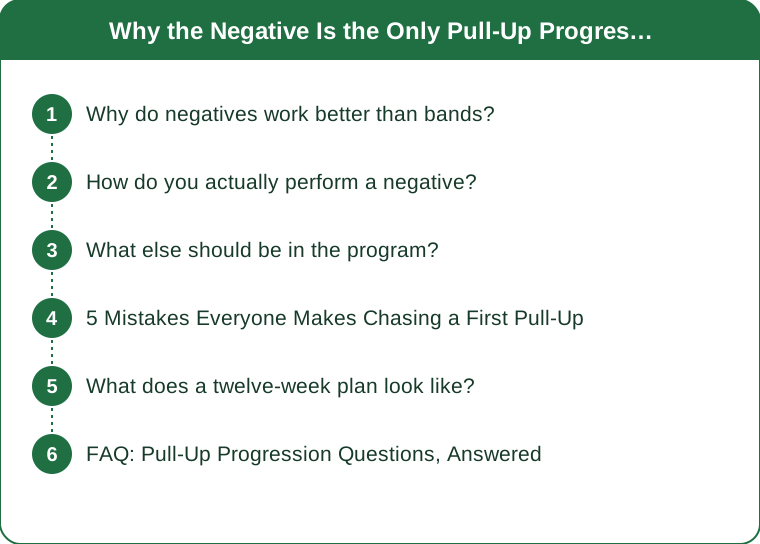
Why do negatives work better than bands?
You are roughly 20 to 50 percent stronger eccentrically than concentrically, which means you can control a lowering you cannot yet perform as a lift. That gap is the entire training opportunity.
Eccentric loading is a strong stimulus for strength adaptation and is well supported for building capacity in a movement you cannot yet complete.
Bands assist most at the bottom - where the band is most stretched - and least at the top. The bottom is exactly where a pull-up is hardest, so bands remove help precisely where it is needed.
That produces a strange strength curve. People get very good at band pull-ups and find the bottom of an unassisted rep still impossible.
Negatives load the whole range, including the dead hang position, under control.
And negatives require no equipment beyond the bar, plus something to step from.
How do you actually perform a negative?
Start at the top. Step, jump or use a box to get your chin over the bar.
Lower for 8 to 10 seconds with control throughout, not a fast drop with a brake at the end.
Reach a full dead hang with arms straight and shoulders engaged, not collapsed.
Step back up rather than trying to pull up, which keeps the set purely eccentric.
Rest 90 seconds to two minutes between reps, because these are far more demanding than they look.
Start with three sets of one and progress to five sets of one, then add duration before adding reps.
And keep the shoulders active at the bottom - shoulder blades pulled down slightly rather than fully relaxed. A fully passive hang at the end of a fatiguing negative is where shoulder discomfort comes from.
What else should be in the program?
Dead hangs, building to 45 to 60 seconds, which develop grip and shoulder stability - the two most common secondary limiters.
Scapular pull-ups - hanging, then pulling the shoulder blades down without bending the arms. This teaches the initiation that most beginners cannot find.
Inverted rows, which build horizontal pulling strength and are easily scalable by changing body angle.
Lat pulldowns if available, which train the pattern with adjustable load, and where reaching roughly body weight for a few reps is a useful benchmark.
Hollow body holds, because a pull-up is a full-body movement and a loose midsection loses energy on every rep.
Three sessions a week works well for most people, with negatives at the start of each while fresh.
And progress by duration, then by set count, then by reps - 8 seconds to 10, three sets to five, then two reps per set.

5 Mistakes Everyone Makes Chasing a First Pull-Up
Living on bands indefinitely. Bands have a place for volume once you can do a rep or two, but as the primary progression they train around the hardest part of the movement.
Dropping fast on negatives. A three-second drop with a brake is not a negative. The whole stimulus is in the controlled lowering, and going from 3 seconds to 8 changes everything.
Testing constantly. Attempting a max pull-up every session is fatiguing and demoralising. Test every two to three weeks, not every workout.
Ignoring grip. Many people fail a pull-up because their hands give out first. Dead hangs and farmer’s carries fix this faster than more pulling does.
Training it once a week. Pull-ups are a skill as much as a strength feat, and frequency drives skill. Three shorter sessions beat one long one comfortably.
What does a twelve-week plan look like?
Weeks 1 to 3: Three sessions a week. Three sets of one 5-second negative, three sets of 15-second dead hangs, three sets of 8 inverted rows.
Weeks 4 to 6: Four sets of one 8-second negative, dead hangs to 30 seconds, inverted rows at a lower angle.
Weeks 7 to 9: Five sets of one 10-second negative, dead hangs to 45 seconds, add scapular pull-ups for three sets of 8.
Weeks 10 to 12: Five sets of two 8-second negatives, and one attempt at a full rep at the start of each session while fresh.
Test at weeks 4, 8 and 12, not weekly.
Expect the first rep somewhere between week 8 and week 16 depending on starting point, body weight and training history. Both ends of that range are normal.
And once you have one rep, keep the negatives. They remain the fastest way to build from one rep to five. This is general information, not medical advice.
FAQ: Pull-Up Progression Questions, Answered
How long does it take to get a first pull-up?
Commonly 8 to 16 weeks of consistent three-times-weekly training. Starting strength, body weight and training history all move that substantially.
Are bands useless?
No - they are useful for building volume once you can already do a rep or two. As a sole progression toward a first rep they train around the hardest position.
How slow should a negative be?
Build to 8 to 10 seconds. Under 5 seconds is mostly a controlled drop and provides much less stimulus.
How often should I train pull-ups?
Three times a week for most people. It is a skill as well as a strength feat, and frequency matters more than session length.
Should I do chin-ups instead?
Chin-ups - palms facing you - are easier for most people because of greater biceps involvement, and they are a perfectly good stepping stone. Many people get a chin-up several weeks before a pull-up.
Why do my hands give out before my back?
Grip is a common limiter. Dead hangs and farmer’s carries build it quickly, and chalk helps more than people expect.
TL;DR:
- You are 20 to 50 percent stronger lowering than lifting - negatives exploit exactly that gap.
- Bands assist most at the bottom, which is the hardest part of a pull-up, so they train around the problem.
- Lower for 8 to 10 seconds under control, step back up, and rest 90 seconds to two minutes.
- Add dead hangs, scapular pull-ups and inverted rows; grip is a common hidden limiter.
- Train three times a week - it is a skill as much as a strength feat.
- Test every two to three weeks, not every session.
Most people get their first rep in 8 to 16 weeks. This is general information, not medical advice.
Keep Reading
This article is for general informational and styling purposes only. Fit, sizing, and product availability may vary.