Why Your Pull-Up Numbers Swing More Than Any Other Lift
Quick Answer: Pull-ups swing more than barbell lifts because the load is your body weight, which fluctuates by a kilogram or two daily, and because grip, bar thickness, and shoulder freshness all vary between sessions in ways a barbell does not. A pull-up is also close to your maximum for most people, so a small change in any factor moves the rep count noticeably. Judge progress over four-week blocks, not session to session.
One week you feel unstoppable and the next you are struggling with a rep count you owned a fortnight ago.
This blog has covered why your grip gives out before your back does and why pull-ups feel easier on a thinner bar. This one pulls those together and explains why the whole exercise feels less predictable than everything else you do.

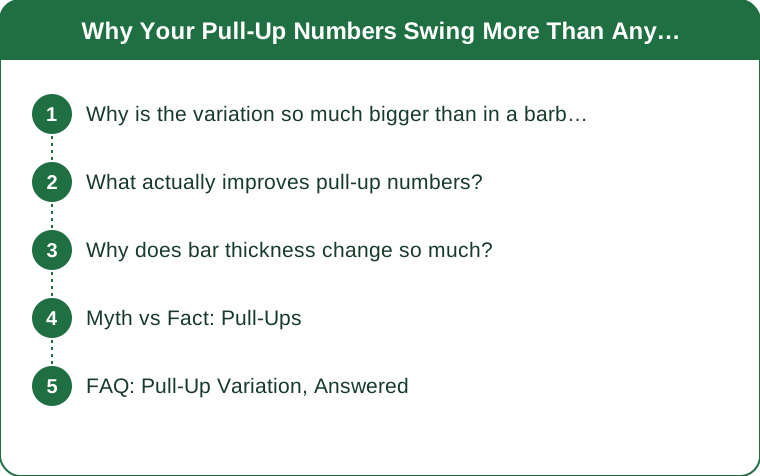
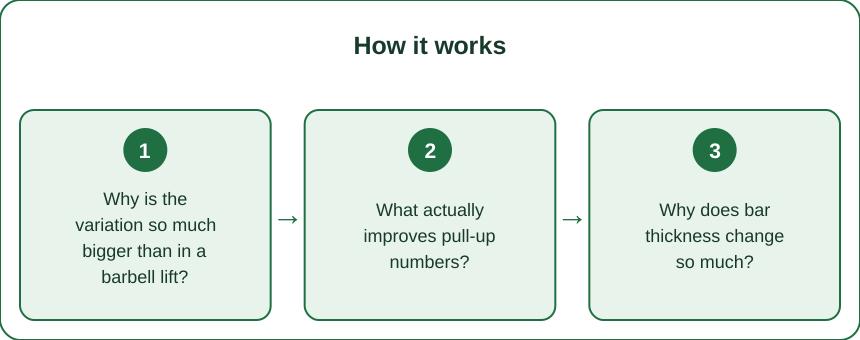
Why is the variation so much bigger than in a barbell lift?
Four reasons, and they stack.
Your body weight is the load, and it changes daily. Normal fluctuation from hydration, food, and glycogen is typically a kilogram or two. On a lift where you are already near your limit, that is the equivalent of adding or removing a plate you did not choose.
A pull-up is close to maximum effort for most people. If your best set is seven reps, you are working at a high percentage of your maximum, and near maximum, small changes in condition produce large changes in reps. Someone doing 20 reps sees far less variation.
Grip is a separate limiting system with its own recovery timeline. Grip fatigues faster than your back and recovers more slowly, and it is affected by everything else you did with your hands that week, including carrying, deadlifting, and manual work.
Equipment varies in ways barbells do not. Bar thickness, texture, whether it rotates, and how far apart the handles are all change the exercise measurably. A thicker bar can cost you multiple reps entirely through grip.
And shoulder freshness matters more here than elsewhere. A pull-up starts from a fully hanging position, which is a demanding shoulder position. If you pressed heavily two days earlier, the starting position alone costs you.
Which is why the number is a poor daily signal and a good monthly one. Almost everyone who tracks pull-ups session to session concludes they are not progressing, when a four-week average would show steady improvement.
What actually improves pull-up numbers?
Volume below failure, grip work, and patience with body weight.
Do more total reps rather than more sets to failure. Multiple sets of two or three reps below your maximum, done frequently, build more than one or two all-out sets. Try five sets of half your maximum reps, several times a week.
Train grip as its own thing. Dead hangs, farmer’s carries, and simply holding the top of the bar for time all build the system that fails first. Two or three short sessions a week is enough and it often produces the fastest visible improvement.
Use bands or an assisted machine to get volume, not to make it easy. The goal is more quality reps in the correct pattern. Assisted reps done with good position beat unassisted reps done with a partial range.
Train the top position specifically. Most people fail at the last third. Slow lowering from the top, and holds at chin height, target exactly the range where the rep is lost.
Do pull-ups first in the session. Their number is more sensitive to prior fatigue than almost anything else, so anything you do beforehand costs you reps and costs you adaptation.
And be patient about body weight. Adding muscle mass makes pull-ups harder in the short term even as you get stronger. This is one of the few lifts where general training progress can temporarily reduce the number, which is genuinely demoralising if you do not expect it.
Frequency beats intensity here. Three light sessions a week outperform one hard session almost universally, because the limiting factors are neural and grip-based rather than muscular size.

Why does bar thickness change so much?
Because grip strength falls off sharply as bar diameter increases.
A thicker bar reduces how much force your hand can generate. Your fingers work at a mechanical disadvantage when opened wider, and the effect is far larger than the diameter difference suggests.
Grip failure ends the set before your back is done. On a thick bar, most people lose the set to their hands while their back still has reps available, which is why the same person gets very different numbers on two bars in the same gym.
Texture matters as much as diameter. A knurled bar grips back and a smooth painted one does not, particularly with sweaty hands late in a session or on a warm day.
Rotating handles remove the forearm’s rotational work. They feel kinder on the elbows and shoulders and they change the exercise, which is worth knowing when comparing numbers between setups.
Chalk is the largest single intervention available. On a smooth bar in a warm gym, chalk can be worth multiple reps immediately. If your gym does not permit it, liquid chalk is usually acceptable and does most of the same job.
And straps are a legitimate tool for back training, not cheating. If your goal is back development rather than a pull-up number, straps let you train the back past the point where grip fails. Keep some sets strapless if the pull-up number itself is the goal.
Myth vs Fact: Pull-Ups
Myth: You should do pull-ups to failure every session. Fact: Sub-maximal volume across the week builds pull-ups faster than repeated maximal efforts, which mostly generate fatigue and shoulder wear.
Myth: Losing weight is the easiest way to add reps. Fact: It works and it is not the easiest. Grip training and increased frequency usually produce faster gains, and weight loss that costs you muscle can leave you weaker rather than better at pull-ups.
Myth: Lat pull-downs transfer directly to pull-ups. Fact: They help and they do not fully transfer, because a pull-up requires stabilising a free-hanging body and a pull-down does not. Use them as a supplement rather than a substitute.
Myth: Kipping is cheating. Fact: It is a different exercise with different goals, demands, and risks. It is not a strict pull-up and it is not automatically wrong, provided you know which one you are training.
Myth: Women cannot do pull-ups. Fact: A tired myth. The strength difference is real and so is the training response, and the same volume-based approach works. The main practical difference is starting point, not ceiling.
Myth: If your numbers dropped, you lost strength. Fact: Far more often you slept badly, ate less, trained your back two days earlier, or used a different bar. Look at the four-week trend before concluding anything.
FAQ: Pull-Up Variation, Answered
Why do my pull-up numbers change so much week to week?
Body weight fluctuates daily, a pull-up sits close to your maximum, grip has its own recovery timeline, and bar thickness varies between setups. All four move the number without any change in strength.
How often should I train pull-ups?
Three or more short sessions a week, with sets kept below failure, beats one hard session. The limiting factors respond better to frequency than to intensity.
Why does my grip fail before my back?
Grip muscles are small, fatigue quickly under sustained load, and recover more slowly than the large back muscles. Dead hangs, carries, and chalk all address it directly, and straps let you train the back separately.
TL;DR:
- Pull-ups swing because your body weight is the load, you are working near maximum, and grip and bar thickness vary between sessions.
- Build them with frequent sub-maximal volume rather than repeated sets to failure.
- Train grip separately with hangs and carries, and use chalk, which is often worth multiple reps immediately.
- Judge progress over four-week blocks, and expect added muscle mass to temporarily reduce the number.
A bad pull-up day is usually a sleep, hydration, or bar-thickness day. Check the monthly trend before you change your program.
Keep Reading
This article is for general informational and styling purposes only. Fit, sizing, and product availability may vary.