Why Your Pull-Up Feels Worse One Day After Training and Better Two Days Later
Quick Answer: Neuromuscular fatigue, glycogen depletion in the lats, and inflammatory swelling all peak roughly 24 hours after hard pulling, then resolve by 48 hours — often leaving you slightly stronger than baseline. This is why the day-after session feels awful and the two-days-later session feels great. Schedule your pull-up work on a 48-hour rhythm rather than daily and the whole thing works in your favor.
The day after a hard back session, your pull-ups are noticeably worse — sometimes two or three reps down. Two days after, they are the best of the week.
This pattern is not random and it is not mostly soreness. Several recovery timelines happen to converge at 48 hours, and once you know that, you can build your week around it.
Here is what is going on.

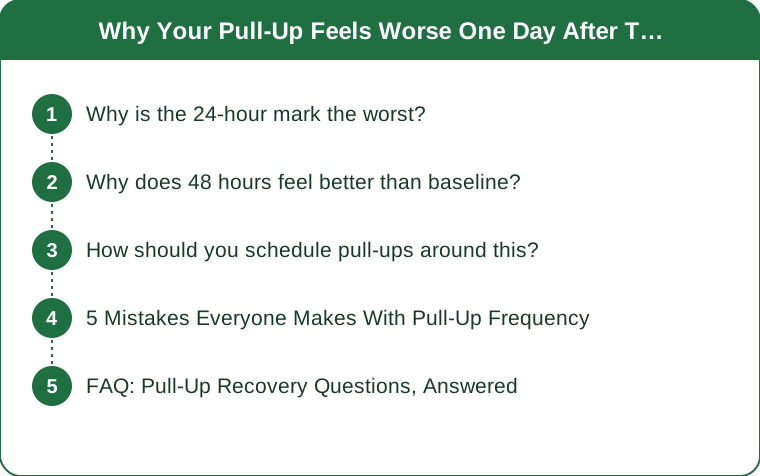
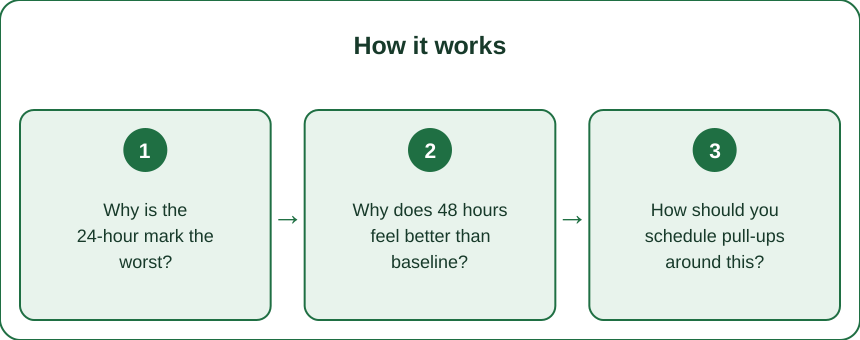
Why is the 24-hour mark the worst?
Because three separate forms of fatigue are all near their peak at the same time.
Neuromuscular fatigue is still present. Your nervous system’s ability to recruit high-threshold motor units is reduced for roughly 24 to 48 hours after demanding work. Pull-ups are relatively high in neural demand, so this shows up clearly.
Glycogen in the working muscles is not fully restored. Lat and forearm glycogen replenishment takes 24 hours or more with adequate carbohydrate, longer without. Local depletion means less available power for the same movement.
Inflammatory swelling peaks around then. The mild swelling and altered tissue stiffness that accompany muscle damage tend to be maximal at 24 to 48 hours, which changes the mechanics of a movement that depends on a long range of motion.
Grip is the visible casualty. Forearm flexors recover more slowly than the lats and are the limiter for most people. Your back is often more ready at 24 hours than your hands are — which is why the failure feels like your grip giving up.
Why does 48 hours feel better than baseline?
Because you are catching the upswing of a well-described fatigue-and-fitness pattern.
Fatigue decays faster than the adaptation. Training produces both fatigue and a small fitness gain. Fatigue dissipates over 24 to 72 hours while the adaptation persists longer, so there is a window where fitness is up and fatigue is mostly gone.
Glycogen supercompensates modestly. With adequate carbohydrate, replenishment can slightly exceed baseline, which contributes to that full, powerful feeling.
Neural drive rebounds. Recovery of high-threshold recruitment can overshoot briefly, which is the mechanism behind peaking protocols in strength sport.
Practice effects add to it. Pull-ups are as much a skill as a strength expression. Recent practice sharpens the pattern, and 48 hours is close enough for the skill to remain fresh while the fatigue has cleared. This is why every-other-day pull-up work progresses faster than either daily or weekly.

How should you schedule pull-ups around this?
On roughly a 48-hour rhythm, with hard and easy days rather than hard and rest.
Three sessions a week is the sweet spot for most people. Monday, Wednesday, Friday or similar. Each session lands on the good side of the curve.
Make the middle session lighter. If you want more frequency, alternate a hard day with an easy technical day — half the volume, no reps to failure. This keeps the skill sharp without adding fatigue.
Do not test on a 24-hour-old session. If you are checking your max reps, do it 48 to 72 hours after your last hard pulling work. Testing at 24 hours gives you a discouraging number that means nothing.
Grip needs its own plan. Because forearms lag, keep dedicated grip work away from your hardest pull-up day, and consider straps for heavy rows so your grip is fresh for the pull-ups that matter.
5 Mistakes Everyone Makes With Pull-Up Frequency
1. Doing pull-ups every day and wondering why progress stalled. Daily work keeps you permanently on the 24-hour dip. Frequency helps, but only if some days are genuinely easy.
2. Judging progress from the day-after session. It is the least informative data point in your week. Compare like with like — same day of the week, same position in the cycle.
3. Training to failure every session. Failure work dramatically extends the fatigue timeline. Stopping one or two reps short lets you train again in 48 hours instead of 72.
4. Skipping carbohydrate after a hard back day. Glycogen replenishment is the piece you can most directly influence. Low-carb recovery reliably extends the dip well past 24 hours.
5. Blaming the grip and doing nothing about it. If your hands quit first, that is a trainable target. Dead hangs and farmer carries on non-pull-up days close that gap in a few weeks.
FAQ: Pull-Up Recovery Questions, Answered
Does soreness tell me anything useful?
Very little about readiness. Soreness and performance decrement follow different timelines, and you can be sore and strong or unsore and weak. Judge by your first working set, not by how your lats feel to the touch.
Is it fine to train pull-ups when they feel bad at 24 hours?
Yes, at reduced volume and away from failure. Light technical work at 24 hours does not meaningfully extend recovery and helps the skill. Grinding heavy sets does.
Why is my third set always the best one?
Post-activation potentiation. Earlier sets prime neural recruitment, so the second or third set can outperform the first. Build in a proper ramp-up and your top set gets better.
This is general information, not medical advice. Elbow, shoulder, or wrist pain that persists between sessions is worth having assessed.
TL;DR:
- Neuromuscular fatigue, local glycogen depletion, and inflammatory swelling all peak around 24 hours, then clear by 48.
- Fatigue decays faster than the fitness gain, so 48 hours often feels better than baseline.
- Train pull-ups on a 48-hour rhythm — three quality sessions a week beats daily work.
- If you want more frequency, alternate hard days with genuinely light technical days.
- Never test max reps at 24 hours, stop one or two reps short of failure, and eat carbohydrate after hard pulling.
- Grip recovers slowest — train it separately and use straps on heavy rows.
The 24-hour dip is the most misread signal in pull-up training. It is not a sign you are overtrained or losing ground; it is the predictable middle of a curve that ends higher than it started.
Keep Reading
This article is for general informational and styling purposes only. Fit, sizing, and product availability may vary.