Why Your Pull-Up Feels Harder in a Cold Gym
Quick Answer: Cold reduces grip strength before it reduces anything else, because hands lose heat fastest and forearm muscles work poorly when cool. Add a colder, more slippery bar and stiffer shoulder tissue, and the pull-up loses more reps to a cold room than any other common lift. Fifteen minutes of general warm-up plus warm hands recovers most of it.
You did seven last week. It is 55 degrees in the garage this morning and you got four, and the fourth was ugly. Your strength did not disappear overnight — it is sitting in your hands, unavailable.

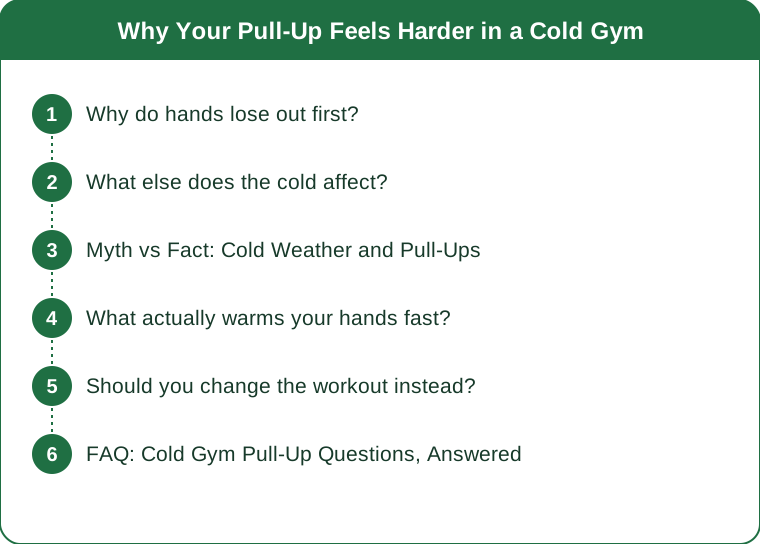
Why do hands lose out first?
Because of surface area, blood flow, and how your body prioritizes heat.
Hands have a very high surface-area-to-volume ratio, so they shed heat quickly. More importantly, when your body detects cooling it constricts blood vessels in the extremities to protect core temperature, which means your hands get less warm blood at exactly the moment they most need it.
Cooler muscle produces less force. Enzyme activity slows, nerve conduction velocity drops, and the muscle becomes stiffer and slower to activate. Research on hand function in cold conditions consistently finds meaningful reductions in grip strength and dexterity, and the effect appears well before the hands feel painfully cold.
For most lifts this barely registers, because grip is not the limiting factor. For pull-ups, grip is very often the thing that fails first even in a warm room — so a stressor that specifically targets grip removes reps directly.
There is a compounding factor too. A cold metal bar conducts heat out of your palms fast, so the longer you hang, the colder your hands get. Your last set is working with colder hands than your first.
What else does the cold affect?
Three secondary factors, in descending order of impact.
Shoulder and lat tissue compliance. Cool muscle and connective tissue are stiffer, so the bottom of the pull-up — the dead-hang position where you need the most shoulder range — feels tighter and requires more effort to initiate out of. People often describe the first rep as feeling stuck rather than heavy.
Bar friction. A cold bar develops condensation when warm hands meet it, and a slightly damp cold bar is genuinely more slippery. Chalk helps considerably here and helps less than you would hope with pure cold.
Neuromuscular readiness. Rate of force development drops when muscle is cool. Pull-ups are relatively fast, coordinated movements compared with a slow squat, so they lose more to a sluggish nervous system.
What is not the main factor, despite feeling like it: overall body warmth. Plenty of people warm up their whole body, feel fine, and still lose reps — because the general warm-up did nothing for their hands specifically, and the hands were the problem.
Myth vs Fact: Cold Weather and Pull-Ups
Myth: You just need a longer general warm-up. Fact: General warm-up helps and is not sufficient. Hand and forearm-specific warming is the piece that recovers the most, and it takes about two minutes.
Myth: Losing reps in the cold means you were never that strong. Fact: It means grip was closer to your limiting factor than you realized. Your back strength is unchanged; the interface between you and the bar got worse.
Myth: Gloves solve it. Fact: Gloves keep hands warm between sets, which is genuinely useful. Worn during the set, most gloves reduce tactile feedback and can make thicker effective bar diameter, which usually costs more than the warmth gains. Wear them between sets, not during.
Myth: The bar temperature does not matter, only air temperature. Fact: Metal conducts heat away from skin far faster than air does. A steel bar at 50 degrees pulls heat out of your hands dramatically faster than 50-degree air, which is why an outdoor bar feels worse than an indoor room at the same temperature.

What actually warms your hands fast?
A short, specific protocol that costs about five minutes.
- Two minutes of general work first — brisk walking, easy rowing, jumping jacks. Get core temperature moving so your body stops prioritizing it over your extremities
- Warm water, if available. Thirty seconds under warm tap water is the single fastest method and it is often overlooked because it feels too simple
- Vigorous hand movement. Fast fist clenches, finger spreads, and arm swings for 60 seconds. Arm swings in particular drive blood to the hands quickly
- A light towel or bar rub. Wiping the bar removes condensation and warms it slightly
- Two easy hang sets before working sets — 10 to 15 seconds each, not to failure. This warms the hands on the actual implement and wakes up the shoulder position
Between sets, put your hands somewhere warm — pockets, under your arms, around a warm drink. Hands re-cool remarkably fast during a two-minute rest in a cold room, and the fourth set can be colder-handed than the first.
One structural fix for anyone training in a cold garage regularly: wrap the bar. A layer of athletic tape or a foam sleeve on a pull-up bar dramatically reduces heat conduction. It slightly thickens the bar, which some people find harder and others find easier, so test it before committing.
Should you change the workout instead?
Sometimes, and it is not a concession.
If the room is genuinely cold and you cannot fix it, a few sensible adjustments:
- Move pull-ups later in the session rather than opening with them. Everything is warmer by then, including hands
- Reduce reps per set and add sets. Five sets of 3 preserves quality far better than two sets of failure with cold, slipping hands
- Use a thicker or wrapped bar deliberately if grip is failing before the back does — or accept a strap for higher-rep back work while training grip separately
- Expect the numbers and log the temperature. Recording room temperature next to your reps for a month makes the pattern obvious and stops you interpreting a cold morning as a lost adaptation
And the honest framing: a cold-weather rep drop is not detraining. It is a temporary reduction in the availability of strength you already have. The people who get discouraged in October are usually the ones who did not know this was going to happen, and it happens to everyone with a garage gym every single year.
As general information rather than medical advice — if cold reliably produces joint pain rather than just reduced performance, particularly in the elbow or shoulder, that is worth a conversation with a physiotherapist rather than a longer warm-up.
FAQ: Cold Gym Pull-Up Questions, Answered
How much strength do you actually lose?
It varies a lot by individual and by how cold, but grip strength reductions in cold conditions are well documented and can be substantial once hands are genuinely cool. For pull-ups specifically, losing 20 to 30 percent of your rep count on a cold morning is a common experience.
Does chalk help or hurt in the cold?
It helps with moisture and grip security, and it does nothing for temperature. Use it, but do not expect it to solve the actual problem. On a cold damp bar, wiping the bar first matters more than the chalk.
Should I skip pull-ups entirely on very cold days?
No need, as long as you warm the hands properly and adjust the set structure. What is worth avoiding is maximal-effort testing in a cold room, since you will get a number that reflects the temperature more than your training.
TL;DR:
- Cold hits grip first, and grip is usually the pull-up’s limiting factor already
- A cold metal bar pulls heat from your palms faster than cold air does
- Warm the hands specifically — warm water, vigorous movement, two easy hangs — not just the body
- Move pull-ups later in the session, use more sets of fewer reps, and log the room temperature
The reps come back the moment your hands do. This is one of the few performance drops in training that is entirely reversible within five minutes, provided you spend those five minutes on the right body part.
Keep Reading
This article is for general informational and styling purposes only. Fit, sizing, and product availability may vary.