Why Your Grip Gives Out Before Your Back Does on Pull-Ups — and How to Fix It
Quick Answer: For many women working toward their first pull-up, grip strength — not back strength — is the actual bottleneck, because forearm and hand muscles are smaller and fatigue faster than the large back muscles doing most of the pulling work, so training grip directly often unlocks progress that back-focused training alone doesn’t.
If your hands and forearms burn out before you feel your back working on a pull-up attempt, that’s a specific, common, and fixable pattern — not a sign you’re weak overall.

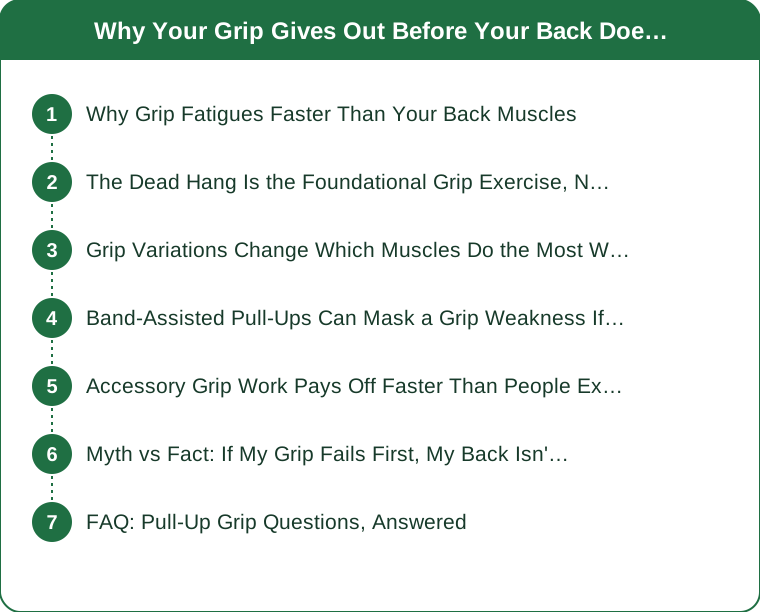
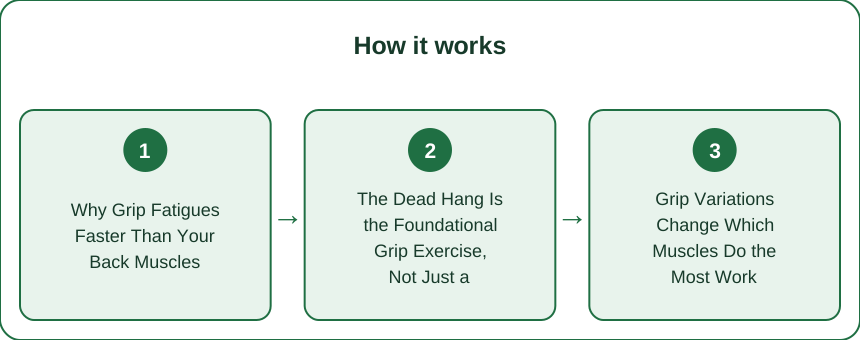
Why Grip Fatigues Faster Than Your Back Muscles
The muscles of the forearm and hand that maintain your grip on the bar are considerably smaller than the large back muscles (lats, rhomboids, traps) doing the actual pulling, and smaller muscles simply fatigue faster under sustained load. During a dead hang or a pull-up attempt, your grip is working continuously and isometrically the entire time, while your back muscles are doing more dynamic, cyclical work — this mismatch means grip often reaches its fatigue limit well before your back does, especially for beginners who haven’t specifically trained grip endurance.
The Dead Hang Is the Foundational Grip Exercise, Not Just a Warm-Up
A simple hang from a pull-up bar, holding for time, is frequently dismissed as a warm-up move, but it’s actually a direct, specific training stimulus for the exact grip endurance a pull-up requires. Building from short holds — even 10-15 seconds for true beginners — up toward 30-45 second holds over several weeks builds the forearm endurance that often becomes the limiting factor once back strength catches up.
Grip Variations Change Which Muscles Do the Most Work
An overhand (pronated) grip places more demand on the forearms and less mechanical advantage on the biceps, while an underhand (supinated) grip, as in a chin-up, recruits the biceps more and is generally somewhat easier for beginners for that reason. Practicing both, along with a neutral grip if your bar allows it, builds grip strength across different hand positions and gives you flexibility in which variation to progress on.

Band-Assisted Pull-Ups Can Mask a Grip Weakness If You’re Not Careful
Resistance bands looped around the bar and under your foot or knee are a standard progression tool, but if a session is entirely band-assisted, your grip isn’t getting challenged to the same degree as your back muscles are, because the reduced load means shorter time under tension for the grip too. Mixing in unassisted dead hangs and negative pull-ups (slowly lowering from the top position) alongside band work ensures grip endurance develops at a similar pace to back strength, rather than lagging behind.
Accessory Grip Work Pays Off Faster Than People Expect
Simple additions like farmer’s carries (walking while holding heavy weights), towel hangs, or plate pinches for a few minutes, two to three times a week, build grip endurance efficiently without adding much to an already-full workout. Many people who plateau on pull-up progress for weeks see movement again within a few weeks of adding dedicated grip work, specifically because it removes the bottleneck that wasn’t showing up as a back-strength problem.
Myth vs Fact: If My Grip Fails First, My Back Isn’t Strong Enough Yet
Myth. A failing grip doesn’t necessarily mean your back strength is inadequate — it often means grip endurance simply hasn’t been trained to match your back strength, which is a completely different problem with a different, more specific fix. Fact: many women can perform a strict pull-up’s worth of back strength on a lat pulldown machine (which doesn’t tax grip the same way) well before they can complete an actual pull-up, which is direct evidence that grip, not back strength, was the limiter.
FAQ: Pull-Up Grip Questions, Answered
How long should a beginner be able to dead hang before attempting real pull-up progressions?
There’s no strict requirement, but working toward a 20-30 second hang gives a reasonable grip endurance base to build pull-up-specific training on top of.
Do grip strengtheners (hand grippers) help with pull-up progress?
They can help overall hand strength, but they train a different type of grip (crushing) than the hanging grip a pull-up requires, so dead hangs and bar work are more directly transferable.
Is it normal for forearms to be sore after focused grip training?
Yes, especially early on — forearm soreness after dead hangs or carries is a normal adaptation response, similar to soreness in any newly-trained muscle group.
TL;DR:
- Grip fatigues faster than your back muscles because the forearm and hand muscles are smaller and work isometrically the whole time
- Dead hangs are a direct, specific grip-endurance exercise, not just a warm-up
- Mix grip variations (overhand, underhand) and don’t rely solely on band-assisted reps
- Dedicated grip accessory work often unlocks pull-up progress that felt stuck for weeks
If your hands give out before your back feels the work, that’s useful information pointing at exactly what to train next — not a sign you need to start over.
Keep Reading
This article is for general informational and styling purposes only. Fit, sizing, and product availability may vary.