Why You Can Do Pull-Ups But Still Struggle With the Same Weight on a Lat Pulldown
Quick Answer: Pull-ups and lat pulldowns train overlapping but not identical movement patterns — pull-ups involve moving your whole body through space with a fixed bar, engaging more stabilizer and grip demand, while a pulldown moves a bar toward a fixed torso with a different force curve, so strength in one doesn’t fully transfer to equivalent ‘weight’ on the other.
It feels contradictory because both look like the same basic movement. The mechanics underneath are different enough that direct weight comparisons don’t hold up.

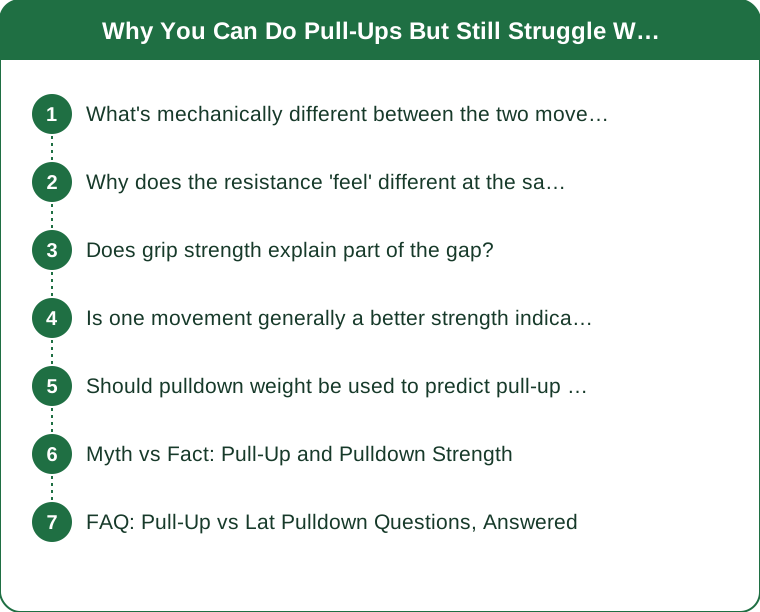
What’s mechanically different between the two movements?
In a pull-up, your torso and body move through space while the bar stays fixed, requiring continuous full-body stabilization throughout the range of motion. In a lat pulldown, your torso stays fixed and the bar moves, removing much of that stabilization demand and changing the resistance curve at different points in the movement.
Why does the resistance ‘feel’ different at the same relative load?
Pull-up resistance is constant (your bodyweight) throughout the whole range, while a pulldown’s resistance can feel lighter or heavier at different points depending on cable angle and machine design — this changes which part of the movement feels hardest, which affects how the same ‘weight’ is actually experienced.
Does grip strength explain part of the gap?
Yes, meaningfully — pull-ups demand continuous grip strength to support full bodyweight for the entire set, while pulldowns, especially with lighter loads, place much less cumulative grip demand, so someone with strong grip endurance may find pull-ups easier relative to their pulldown numbers than expected.

Is one movement generally a better strength indicator than the other?
Neither is universally ‘better’ — pull-ups are a better real-world, full-body strength indicator, while pulldowns are more useful for isolating and building lat strength with adjustable load, which is particularly useful for beginners who can’t yet do a full pull-up.
Should pulldown weight be used to predict pull-up readiness?
It’s a rough guide at best — a common rule of thumb suggests being able to pulldown roughly your own bodyweight for several reps as a readiness marker, but because of the mechanical differences covered above, this is only a loose estimate, not a precise predictor.
Myth vs Fact: Pull-Up and Pulldown Strength
Myth: if you can do 5 pull-ups, you should easily pulldown your bodyweight for 5 reps. Fact: many people who do multiple pull-ups still struggle with bodyweight on a pulldown, because full-body stabilization and grip demand meaningfully change the equation.
Myth: pulldowns are a lesser, ‘easier’ version of the same exercise. Fact: they train the same muscles with a genuinely different mechanical profile — useful as a complement, not just a substitute.
FAQ: Pull-Up vs Lat Pulldown Questions, Answered
Should both exercises be included in a training program, or just one?
Both together tend to work best — pulldowns build isolated lat strength and volume, while pull-ups reinforce the full-body strength and stabilization pulldowns don’t fully train.
Does bar grip width change this comparison?
Yes, somewhat — grip width affects muscle emphasis on both movements similarly, but doesn’t change the core mechanical differences between fixed-bar and moving-bar patterns.
Is it normal for the strength gap to persist even with consistent training?
Some gap is expected to persist long-term since the movements are genuinely different, though the size of the gap generally narrows with training that includes both.
TL;DR:
- Pull-ups require full-body stabilization through space; pulldowns fix the torso and move the bar
- Resistance curves and grip demand differ meaningfully between the two movements
- Neither exercise is a perfect predictor of the other’s strength level
- Training both together builds a more complete pulling strength profile than either alone
If your pulldown numbers don’t match your pull-up reps, that’s expected given how differently the two movements load the body — no need to force one number to match the other.
Keep Reading
This article is for general informational and styling purposes only. Fit, sizing, and product availability may vary.