Why Changing Your Pull-Up Grip Width Actually Changes Which Muscles Do the Work
Quick Answer: Grip width changes the angle and range of motion at the shoulder joint during a pull-up, which shifts emphasis between the latissimus dorsi, biceps, and upper back — a wider grip shortens the range of motion and emphasizes the lats more directly, while a narrower grip increases range of motion and involves the biceps and lower lats more, meaning grip width is a genuine training variable, not just a comfort preference.
Pull-up grip width isn’t interchangeable for training purposes — each width meaningfully changes the muscular emphasis and the specific range of motion the shoulder and arm move through.

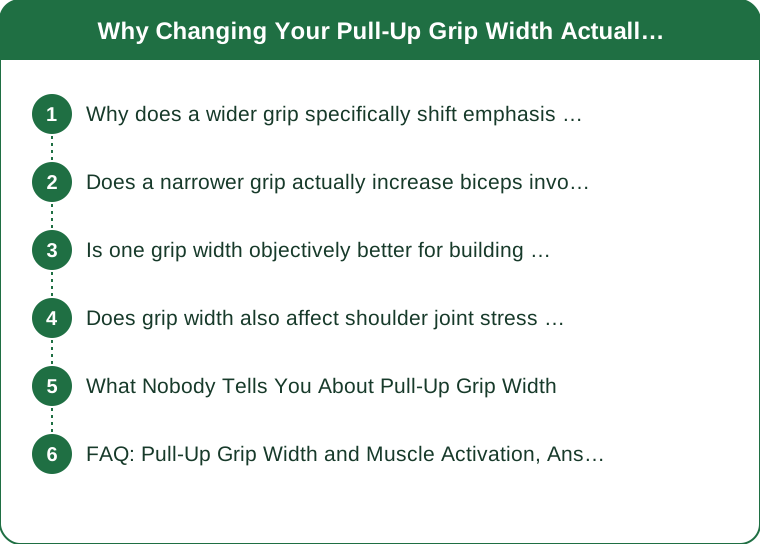
Why does a wider grip specifically shift emphasis toward the lats more than a narrower grip does?
A wider grip positions the arms in a more horizontally abducted position at the top of the movement, which more directly aligns with the latissimus dorsi’s primary line of pull, making the lats the dominant driver of the movement. This wider position also shortens the vertical range of motion, meaning the muscle works through a smaller but more lat-focused arc compared to a narrower grip’s longer pulling path.
Does a narrower grip actually increase biceps involvement, or is that a common misconception?
It’s genuinely supported — a narrower grip increases elbow flexion’s role throughout the pulling motion, and since the biceps are a primary elbow flexor, narrower-grip pull-ups measurably increase biceps activation compared to a wide grip. The longer range of motion a narrow grip also produces means the lower lats and mid-back muscles get worked through a greater portion of the pull as well, not just the biceps.
Is one grip width objectively better for building overall pull-up strength, or does it depend on the goal?
It genuinely depends on the goal — wide grip more directly targets peak lat activation and is often favored for lat width development, while narrow or neutral grip builds more well-rounded pulling strength across a longer range of motion, including meaningful biceps and lower back contribution. Many well-rounded pull-up programs rotate between grip widths specifically to develop the muscle groups each width emphasizes differently.

Does grip width also affect shoulder joint stress or injury risk, separate from muscle emphasis?
Yes, to some degree — an excessively wide grip places the shoulder in a more externally rotated, sometimes less stable position at the top of the pull, which for some individuals increases shoulder strain risk, particularly with poor control or excessive volume. A moderate to shoulder-width grip is often considered a safer default for most people, with true wide-grip work introduced more gradually and with attention to shoulder comfort.
What Nobody Tells You About Pull-Up Grip Width
Grip width preference based on comfort alone doesn’t always align with what’s actually optimal for a specific training goal, and many people default to whatever grip width felt easiest on a first attempt without realizing a different width might better serve their specific goal (lat width versus overall pulling strength versus shoulder-friendly volume) — deliberately testing a couple of different widths, rather than settling on the first comfortable option, often reveals a meaningfully better fit for individual goals and shoulder mechanics.
FAQ: Pull-Up Grip Width and Muscle Activation, Answered
Is there a standard recommended grip width for someone just starting pull-up training?
A shoulder-width to slightly wider grip is commonly recommended as a starting point, offering a reasonable balance of lat engagement and shoulder-friendly positioning for beginners.
Does grip width also affect how pull-up progressions (assisted, negative) should be trained?
Yes — practicing progressions at the same grip width intended for the eventual full pull-up goal ensures the specific muscle emphasis and range of motion being trained actually transfers to that end goal.
Can rotating grip widths across a training week actually accelerate overall pulling strength development?
Many coaches find that rotating grip widths across a week provides more well-rounded muscular development than staying with a single width exclusively, since each width meaningfully challenges a different portion of the pulling muscle group.
TL;DR:
- Grip width changes shoulder joint angle and range of motion, shifting which muscles bear primary load
- Wide grip emphasizes the lats more directly through a shorter, more lat-aligned pulling path
- Narrow grip increases biceps involvement and works through a longer overall range of motion
- Grip width also affects shoulder stress, with moderate width generally considered a safer default
Pull-up grip width is a genuine training variable worth choosing intentionally based on specific goals, not just whichever width happened to feel most comfortable on a first attempt.
Keep Reading
This article is for general informational and styling purposes only. Fit, sizing, and product availability may vary.