Why Grip Strength Gives Out Before Back Strength Does on Pull-Ups
Quick Answer: Forearm and grip muscles are smaller and fatigue faster under sustained isometric load than the larger back muscles doing the actual pulling work, so in most beginner and intermediate pull-up training, grip endurance becomes the limiting factor well before the back muscles reach their own fatigue point — meaning the back often has more pulling capacity left than the failing grip suggests.
The back doesn’t feel tired. The hands, on the other hand, are done — and that mismatch is one of the most common and fixable bottlenecks in pull-up progress.

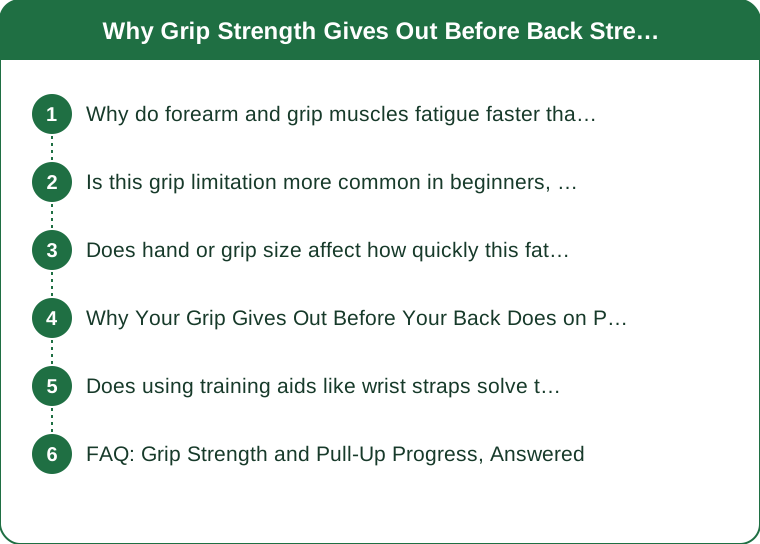
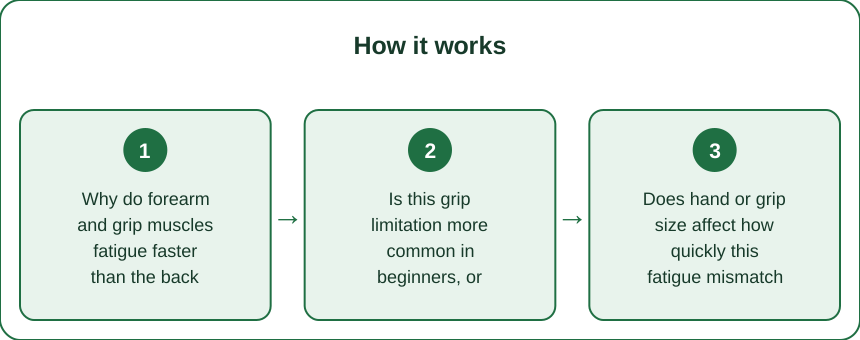
Why do forearm and grip muscles fatigue faster than the back muscles during a pull-up set?
Grip muscles work isometrically (holding a static contraction) for the entire duration of a hang or pull-up set, while back muscles work dynamically through a range of motion with brief moments of reduced tension, and isometric holds under continuous load fatigue smaller muscle groups notably faster than the larger, dynamically-working back muscles doing the primary pulling.
Is this grip limitation more common in beginners, or does it persist for advanced lifters too?
It’s most pronounced in beginners and early intermediates whose grip endurance hasn’t caught up to their developing back strength yet, but even advanced lifters can hit grip limitations during high-volume pull-up work or longer hangs, since grip endurance and back pulling strength develop along somewhat independent timelines.
Does hand or grip size affect how quickly this fatigue mismatch shows up?
Smaller hands generally have less surface area and leverage on a standard pull-up bar, which can make grip fatigue set in slightly faster relative to back fatigue compared to someone with larger hands, though training grip endurance specifically narrows this gap regardless of starting hand size.

Why Your Grip Gives Out Before Your Back Does on Pull-Ups — What Nobody Tells You
Many people interpret early grip failure as a sign they’re not strong enough for pull-ups yet and focus training entirely on back exercises, when the more effective fix is often direct grip and dead hang training, since the back may already have adequate pulling strength that grip endurance simply isn’t unlocking yet.
Does using training aids like wrist straps solve this problem or just bypass it?
Straps bypass the grip limitation during a specific set, which can be useful for allowing enough back-focused training volume to progress, but they don’t build grip endurance itself, meaning relying on straps long-term without any separate grip training leaves the underlying mismatch unaddressed for unassisted pull-ups.
FAQ: Grip Strength and Pull-Up Progress, Answered
What’s an effective way to train grip endurance specifically for pull-ups?
Dead hangs held for increasing duration, done a few times per week separate from pull-up training itself, are one of the most direct and effective ways to build the isometric grip endurance that pull-ups specifically demand.
How long should a beginner be able to dead hang before grip stops being the main limiter?
Working toward roughly 30-45 seconds of a solid dead hang is a reasonable benchmark that suggests grip endurance is no longer the primary bottleneck for most beginner to intermediate pull-up progressions.
Does grip training risk slowing back muscle development by taking training time away from it?
No — grip training is typically brief (a few minutes of hangs) and doesn’t meaningfully compete with back training volume, making it a low-cost addition that often unlocks more effective back training rather than detracting from it.
TL;DR:
- Grip muscles fatigue faster under isometric load than the larger, dynamically-working back muscles during pull-ups
- This mismatch is most common in beginners but can affect anyone during high-volume or longer hang work
- Early grip failure doesn’t always mean insufficient back strength — it often means undertrained grip endurance specifically
- Dedicated dead hang training, done separately from pull-up sets, directly addresses the actual bottleneck
When the hands give out before the back feels worked, that’s a grip endurance gap, not a back strength ceiling — and a few minutes of dead hang training each week is often the fastest way to close it.
Keep Reading
This article is for general informational and styling purposes only. Fit, sizing, and product availability may vary.