The Perfect Pull-Up: The Muscles, the Form Checkpoints and the Faults That Steal Your Reps
The pull-up looks like one movement and is actually a sequence — the scapular set, the drive, the chin-over finish — and most struggling reps fail at a specific, fixable checkpoint. The form guide: the muscles, the rep anatomy and the fault library.

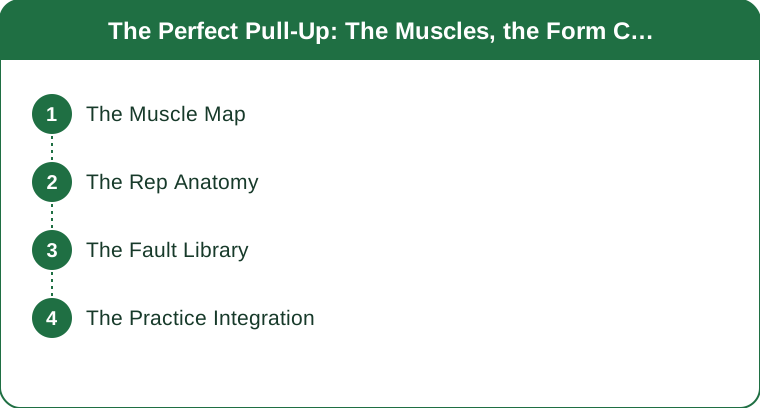
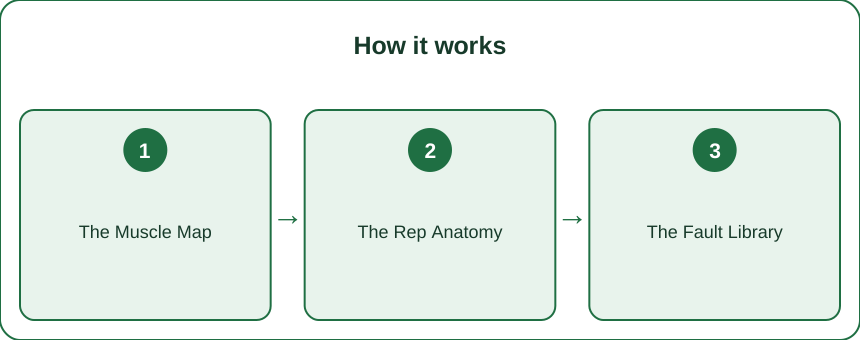
The Muscle Map
Who does what: the lat engine (the latissimus dorsi as the prime mover — the armpit-to-hip sheets that pull elbows down; the width-and-power muscle from the back doctrine), the scapular team (the lower traps and serratus controlling the shoulder blades — the set-and-rotate choreography that healthy reps require per the shoulder doctrine), the arm assist (the biceps and forearms — the chin-up grip’s bigger biceps role from the grip doctrine; the grip endurance from the hang doctrine), the core cylinder (the hollow-body tension that stops swinging — the pull-up being a moving plank per the core doctrine), the often-missed rear delts and rhomboids (the mid-back finishers at the top), and the training implication (the pull-up building half the upper body at once — the compound doctrine’s pulling crown; the muscle map explaining why rows-hangs-and-core all feed the rep).
The Rep Anatomy
Checkpoint by checkpoint: the setup (the grip just outside shoulders, the full hang with shoulders AT the ears — the dead-hang start from the standards doctrine), checkpoint one — the scapular set (the shoulder blades pulled down-and-back BEFORE the arms bend — the scap pull-up as its own drill; the shrugged-shoulders pull being the most common fault’s origin), checkpoint two — the drive (the elbows driven DOWN toward hips, not backward — the lat-firing cue; the chest-toward-bar orientation with a slight lean back), checkpoint three — the finish (the chin cleanly over — the throat-toward-bar honesty versus the chin-poke cheat; the elbows finishing toward the ribs), checkpoint four — the descent (the controlled 2-second lower through full range — the drop-and-bounce robbing the eccentric’s strength value per the negative doctrine; the return to the full hang between reps), and the breathing pattern (the exhale on the pull, the inhale at the hang — the brace maintained per the breathing doctrine).

The Fault Library
The rep thieves, fixed: the shrugged pull (the shoulders at the ears throughout — the fix: the scap-set checkpoint drilled; the scap pull-ups 3x8 as homework), the kip-and-swing (the legs pumping momentum — the fix: the hollow-body hold imported; the toes-pointed-together cue; the slow-tempo reps that make cheating impossible), the half-range rep (the chin-almost and the elbows-never-straight bottom — the fix: the full-hang reset each rep; the range honesty from the standards doctrine; the fewer-but-full recount), the chicken-neck finish (the chin poked over while the body stays low — the fix: the throat-to-bar target; the rep judged at the chest, not the chin), the elbow-flare pull (the elbows winging wide stressing shoulders — the fix: the elbows-to-ribs finish cue; the grip narrowed a hand-width), the death-grip drain (the white-knuckle hold wasting forearm — the hook-grip relaxation from the grip doctrine), and the video audit (the side-angle phone check from the form doctrine — the felt-versus-real gap that film closes).
The Practice Integration
Building the perfect rep: the drill menu (the scap pull-ups, the hollow holds, the slow negatives — the checkpoint-isolating exercises; the flexed-arm hang at the top position), the warm-up placement (the band pull-aparts and hangs before pulling from the warm-up doctrine — the shoulders prepared), the quality-volume law (the sets ended when form leaves — the crisp-or-rest doctrine; the standards that keep every rep building the right pattern), the grip-variation rotation (the chin-up, neutral and wide grips from the grip doctrine — the same checkpoints across all), the strength-transfer note (the perfect rep carrying to lat pulldowns, rows and climbing — the pattern taught once serving everywhere per the transfer doctrine), and the closing standard (the rep that starts dead, sets the blades, drives the elbows and finishes throat-high — the pull-up worth counting; the form that protects shoulders for decades of reps per the longevity doctrine; the perfect rep, assembled checkpoint by checkpoint). Set the blades first, drive elbows down, chin honestly over: the rep, perfected.
The rep is a sequence: dead hang, scapular set BEFORE arms bend, elbows driven down, throat toward bar, controlled 2-second descent. Most failures are checkpoint faults — shrugged shoulders, kipping, half range — each with a specific drill fix.
Keep Reading
This article is for general informational and styling purposes only. Fit, sizing, and product availability may vary.