Chin-Up, Pull-Up, Neutral: Which Grip Is Yours (and Why It Matters)
Quick Answer: The three pull-up grips train differently. Chin-ups (palms toward you) recruit the biceps fully and are the strongest grip for most women — the right one for your first rep. Neutral (palms facing) sits in between and is kindest to elbows and shoulders, making it the volume grip. Pull-ups (palms away) are the most lat-dominant and usually arrive last.
The bar offers three handshakes: palms toward you, palms away, palms facing each other.
The choice changes which muscles do the work, how hard the rep is, and your realistic timeline to that first unassisted rep. Most people pick a grip by accident and then wonder why progress stalled.
Here’s the grip taxonomy, decoded for the ladder-climbers.

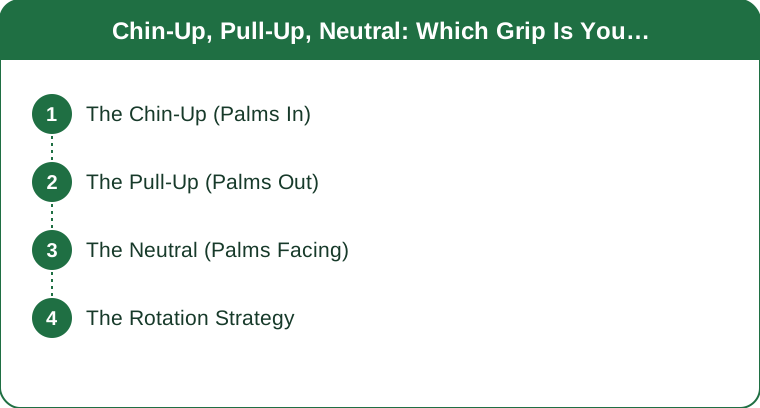
The Chin-Up (Palms Toward You)
The biceps join the lats fully in this position, which makes chin-ups the strongest grip for most women and the classic first-rep grip.
EMG studies consistently show greater biceps activation in the supinated (palms-in) grip compared to pronated, with lat activity remaining high. You’re not trading back work for arm work — you’re adding a strong muscle group to the effort.
Zero shame tier: a chin-up is a full vertical pull. The palms-in start is strategy, not concession. Anyone who tells you otherwise has an opinion, not a reason.
Grip width: shoulder-width or slightly narrower. Keep the shoulders pulled down and back at the start rather than hanging passively — that initial scapular set is where most failed reps are actually lost.
The Pull-Up (Palms Away)
The back-dominant grip. Lats lead, biceps assist less, and it’s typically the last of the three to arrive — expect pull-ups a few months after chin-ups for most people.
The wider the grip, the more lat-isolated and the harder the rep gets, because you shorten the range the biceps can contribute to. Shoulder-width to slightly wider is the honest standard; the very wide grip you see in photos is a specialization, not a default.
If you can do chin-ups but not pull-ups, that’s normal and not a plateau. It’s a different exercise with a different strength profile.

The Neutral Grip (Palms Facing)
The diplomatic grip. Strength sits between the other two, and it’s the kindest to cranky elbows and shoulders because the forearm’s neutral rotation reduces stress at both joints.
That makes it the volume grip — the one to accumulate reps on once rep one exists anywhere. If your elbows complain after a chin-up session, neutral is where the same work goes without the complaint.
It requires neutral handles, parallel bars, or rings. Worth seeking out; a cheap pair of gymnastic rings solves it permanently and folds into a drawer.
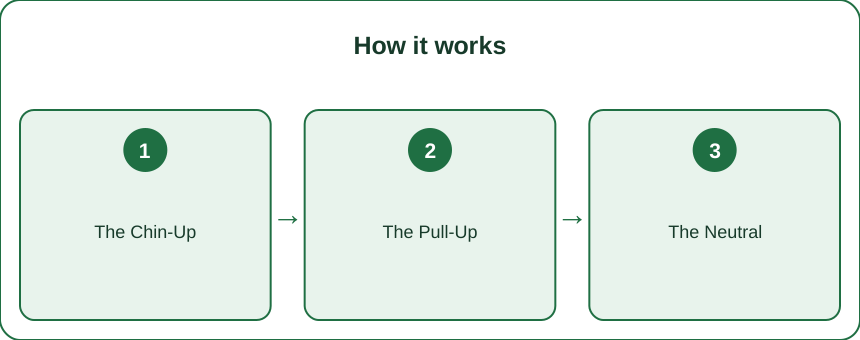
How Should You Rotate the Grips?
The progression play, in order:
- Earn rep one on chin-ups. Strongest grip, fastest route to the milestone that keeps you training.
- Build volume on neutral. Once you have a rep or two, neutral lets you accumulate the reps that build actual capacity, without the joint cost.
- Graduate to pull-ups. The lat-dominant version arrives once there’s a base underneath it.
But train all three across the week rather than sequentially abandoning each. Each grip’s weakness is another’s specialty, and rotating keeps elbows and shoulders happier than hammering one.
A workable week: chin-up work on day one, neutral volume on day three, pull-up attempts or negatives on day five. 2–3 sessions weekly, 3–5 sets each, stopping 1–2 reps short of failure on most sets.
The bar was never one exercise. It was three, holding hands.
What Nobody Tells You
Negatives are the highest-value drill. Jump or step to the top position and lower for 3–5 seconds. Three sets of 3–5 negatives, twice a week, builds first reps faster than any band assistance.
Band assistance lies at the bottom. Bands give most help exactly where you need it least — at the bottom, where you’re strongest relative to the movement — and least at the top, where reps fail. Useful, but pair it with negatives.
Dead hangs build the grip that limits you. Plenty of people fail a pull-up because their hands give out first. 3 × 20–30 seconds twice a week fixes that quietly.
Bodyweight is part of the equation and nobody enjoys saying so. Pull-ups are a strength-to-weight exercise; both variables move the number. That’s a neutral fact, not a prescription.
Progress is not linear. Rep one is famously the hardest, and the gap between zero and one is often longer than between one and five.
When Should You Back Off or See Someone?
Stop and reassess if you get sharp elbow pain (medial or lateral epicondyle), shoulder pain at the bottom of the hang, or any numbness or tingling in the hands.
Persistent joint pain that lasts beyond a couple of days, or pain that’s getting worse session over session, is worth a physiotherapist’s eyes. Pull-ups load the shoulder and elbow substantially, and the fix is usually a technique or volume adjustment rather than stopping altogether — but that’s an assessment, not a guess.
Mini FAQ
How long does it take to get a first pull-up?
Highly variable, but 3–6 months of consistent twice-weekly work is a common range for someone starting from zero. Chin-ups typically arrive first, sometimes by a couple of months.
Are assisted pull-up machines useful?
Reasonably, for building volume. They share the band’s weakness of assisting most at the bottom, so treat them as a supplement to negatives and rows rather than the main driver.
What else should I train to get there faster?
Rows (any variety), lat pulldowns, and hollow-body holds for the core tension that keeps you from swinging. A strong horizontal pull transfers well, and core stability is a surprisingly common limiter.
TL;DR:
- Chin-ups (palms in): strongest grip, biceps fully involved, the right one for rep one.
- Neutral (palms facing): mid-difficulty, easiest on elbows and shoulders, best for volume.
- Pull-ups (palms out): most lat-dominant, usually arrives last. Shoulder-width is the standard.
- Rotate all three across the week; each grip’s weakness is another’s specialty.
- Add negatives (3–5 sec), dead hangs and rows — and stop for sharp joint pain.
Chin-ups first, neutral for volume, pull-ups as the graduation. The grips were always a ladder within the ladder — climb them in strength order and rep one arrives sooner on every count.
Keep Reading
This article is for general informational and styling purposes only. Fit, sizing, and product availability may vary.