Assisted Pull-Up Band Sizing: Why the Wrong Band Stalls Your Progress
Quick Answer: Your band should let you complete 5-8 reps with real effort on the last 2 — if you’re breezing past 12+ reps easily, the band is too thick and assisting too much, which slows real strength progress. Size down in assistance as soon as reps get easy, not on a fixed schedule.
You’ve been using the same thick band for months, doing sets of 15 pull-ups that feel easy. That’s not progress stalling by accident — it’s a predictable result of over-assisting for too long.

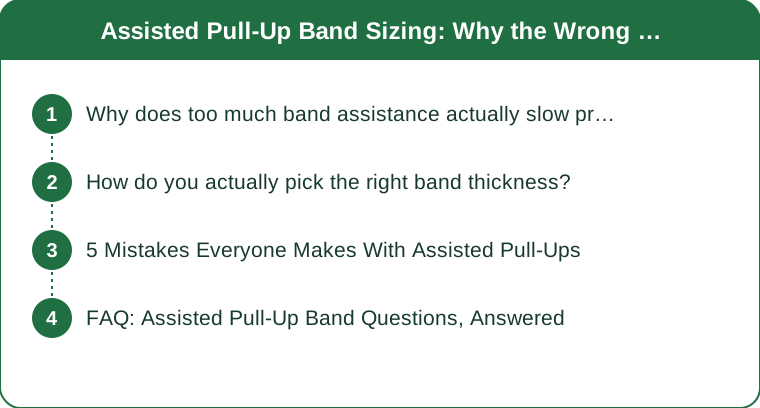
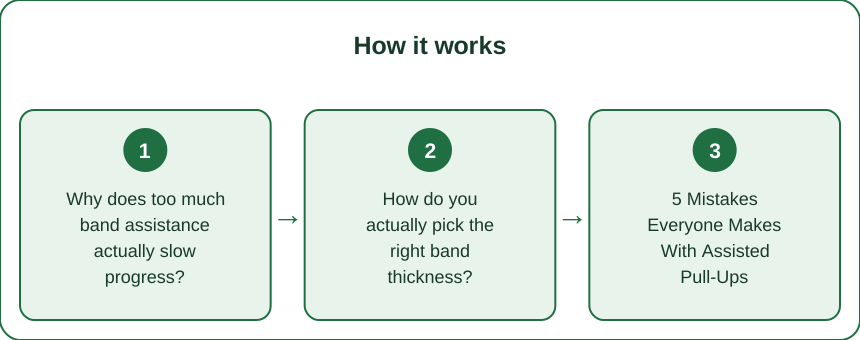
Why does too much band assistance actually slow progress?
Bands work by removing a percentage of your bodyweight from the movement — a thick band might remove 40-50 pounds of resistance. If that leaves the exercise too easy, your muscles aren’t working hard enough to trigger the strength adaptations needed to eventually pull your full bodyweight.
This is the same principle as any strength exercise: near-failure effort in a reasonable rep range (5-8) drives progress far more reliably than high-rep sets that never get genuinely hard.
How do you actually pick the right band thickness?
Test with a rep-based rule: you should struggle to complete reps 6 through 8, with the last 1-2 reps requiring real effort. If you can do 12+ reps without much struggle, move to a thinner band immediately — don’t wait for a scheduled progression check-in.
Most gyms stock a range from thick (most assistance) to thin (least); work down that range roughly every 2-4 weeks as reps become consistently easy, rather than sticking to one band for months out of habit.

5 Mistakes Everyone Makes With Assisted Pull-Ups
1. Staying on the same band too long out of comfort. If reps feel easy, that’s your cue to progress, not a sign to stay put.
2. Chasing higher reps instead of harder reps. 15 easy assisted reps build less strength than 6 hard ones — rep count isn’t the real progress metric here.
3. Skipping negative (eccentric) reps. Slow 3-5 second lowering phases build real strength even before you can do a full unassisted pull-up.
4. Ignoring grip and back strength work separately. Rows and dead hangs build supporting strength that pure banded pull-ups don’t fully cover.
5. Expecting linear weekly progress. Pull-up strength often improves in plateaus and sudden jumps, not a smooth weekly line — that’s normal, not a sign something’s wrong.
FAQ: Assisted Pull-Up Band Questions, Answered
How often should I size down my band?
When you can comfortably complete more than 8-10 reps with good form for 2 sessions in a row, it’s time to move to a thinner band.
Are negative pull-ups better than banded pull-ups for progress?
They work differently — negatives build eccentric strength effectively with no band needed, while banded reps let you practice the full concentric-eccentric movement. Combining both tends to work best.
How long does it typically take to go from banded to unassisted pull-ups?
Highly individual, but many women see a first unassisted rep within 8-16 weeks of consistent, appropriately-sized progressive training — much longer with a habitually over-thick band.
TL;DR:
- Your band should make reps 6-8 genuinely hard — 12+ easy reps means it’s too thick
- Size down as soon as reps get easy, not on a fixed monthly schedule
- Slow negative reps build real strength even before your first unassisted pull-up
- Progress often comes in plateaus and jumps, not a smooth weekly line
Test your current band today — if you can do more than 10 easy reps, it’s time to size down.
Keep Reading
This article is for general informational and styling purposes only. Fit, sizing, and product availability may vary.